Monday, February 14, 2011

Blog 12: Circuits, Pickle Lamps

     Now in physics, we're learning about circuitry. Resistors are a big part of learning about circuits and also play a major role in our daily lives. Many things in our houses are resistors like light bulbs and TVs and radios. All these appliances work by affecting the flow of electrons through the circuit. Just like blowing through straws of different radius and length affects the air flow through the straws, the electricity the resistor receives is dependent on the geometry of the wires.

But what happens when the resistor is a pickle?


There is a lot of science (physics AND chemistry!) involved in this light show which I could attempt to explain, but I think that this video explains the science much better than I ever could. Basically it talks about the uneven resistance of the pickle causing voltage differences and the electrons of the sodium atoms inside the pickle to excite to a higher energy level, emitting photons of light... and all that good stuff.
 
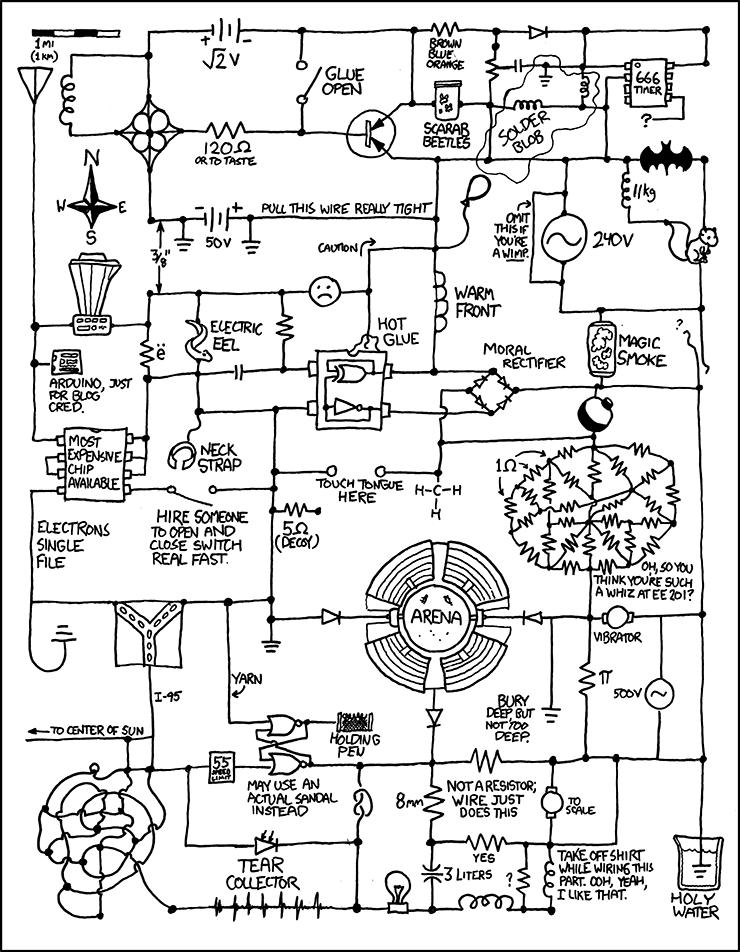
But, for a cirtuitry lesson with less depranger, look to xkcd.

And also, check out this link that was in the discussion about this picture. 
Someone that plays an instrument, please play this for me. :] 
I will look forward to your moon walk.
(p.s. Here's the link for this picture if you can't see it: http://www.whitetreeaz.com/gibber/faeries_aire_and_death_waltz.jpg)

Monday, January 31, 2011

Blog 11: Magnetics, Ferrofluid


Ferrofluid is a liquid that contains iron, which means it can be affected by a magnet. In this video, these people use a magnet to play with the ferrofluid. notice that the spikes are radiating outward from the magnet; they are following the electric field lines around that magnet. Also, the spikes are only around the magnet because they are being affected by the magnet's electric field. Doesn't it look so cool?

But, there is much more science going on here than I can tell you at the moment. This video explains a more in depth reason for why ferrofluid does what it does.

Tuesday, January 18, 2011

Blog 10: Heat, Playing Tennis on the Hottest Day EVER

This weekend, me and some friends decided to meet up for some friendly doubles. Too bad we planned it on the day with what had to have been the hottest afternoon in the whole week. But, that turned out to be a good way to experience physics anyway, so the heat wasn't all that bad.

In this first picture, you see one of the legs of a regular tennis bench touching the tennis court. When everyone was tired from tennis and ready to take a break, we decided to sit on the benches instead of the ground. But why? Well, besides being a normal human convention, sitting on the bench was cooler than sitting on the ground. This is because the specific heat of the bench must have been greater than that of the ground, meaning it heat up relatively slower than the ground. The leg and the ground though, are touching. So actually, if no more heat were added to the system, the two would reach an equilibrium temperature by the zeroth law of thermodynamics and conduction.


Now let's zoom out  because obviously that first picture wasn't physics-y enough anyway. Now we can see Max touching the bench! Because of the zeroth law and conduction, heat diffuses between himself and the bench, allowing the two to come close to an equilibrium. This is why eventually, the bench won't feel warm anymore. Also, as you might be wondering, where is all this heat coming from anyway?? The answer is the sun of course; heat travels by radiation from the sun to earth. And while we're on the subject of ways to transfer heat, convection was also present in the air around the hot tennis court, sadly adding to our discomfort.

Monday, December 13, 2010

Blog 9: Sound, Dancing Water

Here's a great example of resonance in action!
http://www.youtube.com/watch?v=_RBwj3HUOi0&feature=related

The movement of the person's hands creates vibrations which eventually match up with the resonance of the bow. This means that each successive time the resonance is correct, the intensity of that driving force has a greater effect on the bowl and the water in it. When this effect is strong enough, we can see the water rippling and "dancing".

Monday, December 6, 2010

Blog 8: fluids and buoyancy, I love ravioli ^-^

     So a few nights ago my parents decided to go to a bar to watch the UH football game. This left me at home and dinnerless. It was okay though because I was saved by one of my favorite dinners: (spinach and cheese) ravioli!!! 
     I heated the water (but I didn't watch it the whole time, sorry dad) and put the delicious, but cold from the refrigerator, pieces into the water. Then all I had to do was wait until they were ready. (For anyone who doesn't know, you can tell when pasta things are ready when they float.) It was then that I wondered why this was so.


<-----   Sinking pasta


Floating pasta    ------->


(sorry, I know they kinda look the same but trust me, they aren't)
  
     Then I realized that maybe the water had changed. Since the ravioli was cold at first, maybe it made the water cold. Cold water is less dense than hot water so the density of the ravioli at first, would have been more than the density of the water. Then, when the water was hot, it had a higher density so the ravioli could have floated.
     My other theory about this was that the ravioli had at first been more dense because they had just came out of the refrigerator. Then, as time went on, they could have absorbed some water and expanded. By doing this, the ravioli's volume would have increased and its density would have gone down. (density = mass/volume)
     Well, either way I'm not so sure what this had to do with my dinner being done, but it worked and I had a nice dinner.

Sunday, November 21, 2010

Blog 7: Gravity, Orbits, The Universe!

      This chapter, we're learning about gravity and orbits. This stuff is really exciting because it affects not only our everyday life, but also accounts for those wondrous sights in the space around us! I could tell you about all this, but I'd rather show you.
      I found this cool page where you can take a tour of the universe with the interactive universe. It shows all the planets (even poor Pluto) and some of the many other things out there like black holes (which we've been learning a bit about) and even Halley's comet. Don't forget to turn on your sound for some spacey music!

Now that you're done exploring, time for the physics.

The first thing that caught my eye about this tour of the universe was the fact that it showed Halley's comet because we've been learning about it a bit to learn about orbits. The force of gravity affects the comet all the way around its orbit (and causes the orbit). Also, the comet's PE is greatest when it is at its perihelion distance and its KE is greatest at its aphelion distance. So since we're around Halley's aphelion distance, a place where KE, and therefore speed, is great, it means the comet is going really fast when it comes near Earth!
The second thing that I noticed was the other comet, Comet Hale-Bopp. If you thought 74 years was a long time to wait, think again. Comet Hale Bopp only comes every 2038 years - an actual once in a lifetime experience (or maybe more than one lifetime). Just look at the size of its orbit! It passes nicely by earth but its whole orbit doesn't even fit in the picture! Also, Hale-Bopp was visible for 19months to the naked eye. This very long time makes sense, as we are near Hale-Bopp's perihelion, the distance at which PE is the greatest and velocity is the lowest.
Monday, November 15, 2010

Cavendish!

I thought that name sounded familiar. This isn't the same Cavendish from physics, but i think this video is pretty cool.

click "Video: Two Days in the Studio with Nellie McKay" to play the video!
http://www.npr.org/templates/story/story.php?storyId=89287187